
Can your denial management process handle twice the volume without adding staff? Ours can.
Clinical denial management has long been one of the most labor-intensive aspects of revenue cycle management. Each denial requires careful review of clinical documentation, understanding of payer policies, and crafting of customized appeal letters. It’s specialized work that traditionally required experienced staff and significant time investment.
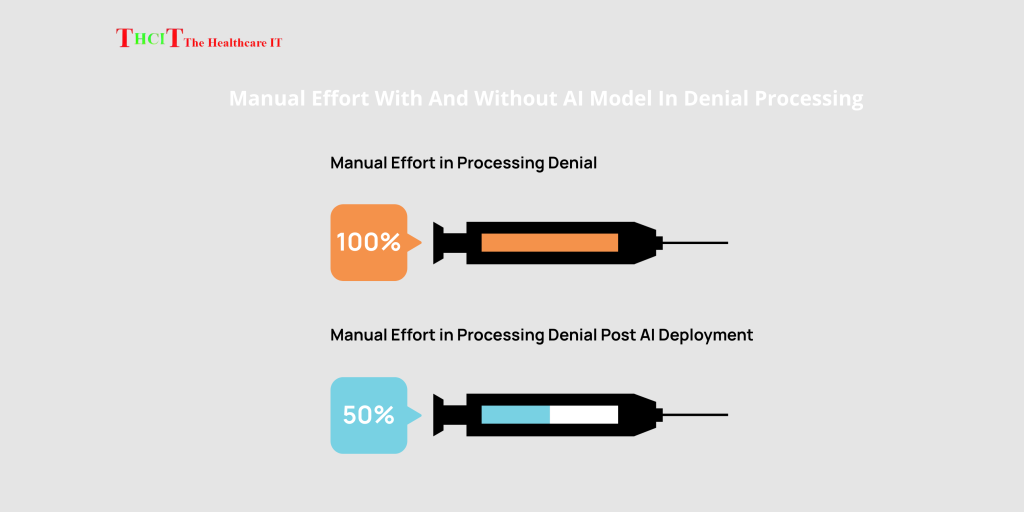
That changed when we implemented AI technology specifically designed for denial management. The system now automatically reviews clinical denials and generates appeal letters, reducing processing time by 50% and cutting manual effort by 30-40%.
The key to success wasn’t just implementing new technology—it was combining AI capabilities with deep healthcare domain knowledge. We needed to ensure the system understood the nuances of clinical documentation, coding requirements, and payer-specific policies. This required collaboration between clinical experts, revenue cycle specialists, and technology teams.
Implementation followed a phased approach, starting with simpler denial types and expanding to more complex scenarios as the system gained accuracy. We continuously refined the AI models based on appeal outcomes, creating a feedback loop that improved performance over time.
The most significant benefit wasn’t just efficiency—it was consistency. The AI system applies the same level of thoroughness to every denial, eliminating the variability that can occur with manual processing. This has led to more successful appeals and improved recovery rates.
Has your organization explored AI for denial management? What challenges have you encountered in automating this complex process? I’d love to hear about your experiences in the comments!
DenialManagement #HealthcareAI #RevenueCycleOptimization

