
A door may be closing in the US, but a bigger one is opening in India — the new H-1B visa rule is poised to boost healthcare tech opportunities here.
US healthcare business in India” means Indian companies or units operating in India providing healthcare/health-tech services, support, R&D, outsourcing, or collaboration that relate to US healthcare systems. Here are some key impacts:
Talent Mobility & Staffing
- Indian professionals who previously could be hired under H-1B and stationed in the US (e.g. for clinical software work, health IT, medtech validation, regulatory affairs, AI/ML in diagnostics) will be much more expensive for US companies to sponsor owing to this fee. This makes sponsoring less attractive except for very high-value / senior/specialized roles.
- For many mid- or junior-level roles, companies may prefer local US hires, or shift functions to India (or other locations) rather than move Indian staff to the US due to cost.
- Indian healthcare businesses may see fewer opportunities to place employees in the US under H1-B, which can affect knowledge transfer, collaboration, and the prestige / career path attractiveness of those roles.
Business Model & Outsourcing Strategy
- US healthcare tech firms that outsource R&D, software development, medical data processing, AI/ML work to India may change the proportions of what they outsource vs what must be done in the US. Suppose on-site US work becomes significantly more expensive (due to visa, travel, and compliance costs). In that case, more work may remain fully remote from India or be handled by India-based teams without relocation.
- Companies might adjust contracting: more remote work, fewer onsite positions. They might also insist that Indian partners deliver more “turnkey” work without sending people to the US.
- Healthcare businesses could also increase investments in local capacity in India, e.g. upskilling, hiring, building labs or R&D centres there, to avoid dependence on moving people to the U.S.
Cost Pressures & Pricing
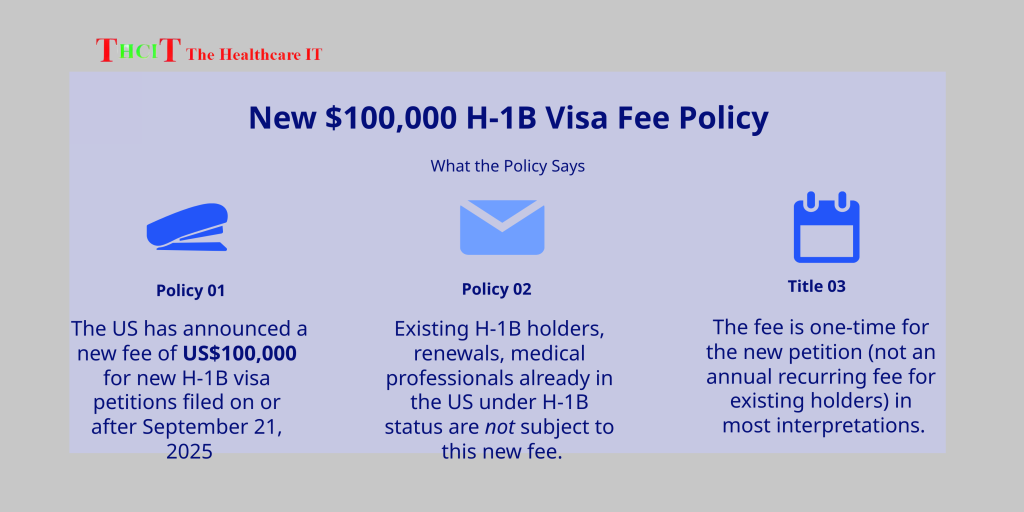
- The $100,000 fee adds a large fixed cost component for any Indian company or unit whose employees are going to be relocated under H-1B. That could force them to raise prices for certain services, especially those that involve onsite US work or require US presence (e.g. clinical validation, regulatory submission support, user-testing, etc.).
- If companies try to pass this cost onto US clients, that may reduce competitiveness vs competitors in other countries whose visa regimes are less expensive.
- Margins may be squeezed in healthcare tech segments, especially those with tighter budgets (startups, smaller medtech firms, non-profit research, diagnostics companies), because they may have fewer premium specialized roles justifying the cost.
Shift in Where Innovation Happens
- Some healthcare innovation (e.g. AI for diagnostics, clinical trials ICT infrastructure, medtech R&D / prototyping) might increasingly happen in India (or other countries) rather than being partially moved to the US or having mixed US-India R&D teams.
- Knowledge transfer, regulatory compliance, and standards development may have to be done remotely or via partnerships rather than by directly moving personnel.
- India could benefit in a sense: firms in India may capture more of the work that would otherwise be done in the US by relocating their operations or teams, given the increased cost of sending staff to the US.
Risk of Disruption / Uncertainty
- Because the policy was announced with little lead time, companies may face uncertainty in project planning, staffing, compliance. Healthcare companies often have long regulatory timelines, letter of approvals, etc., and sudden visa policy shifts can disrupt ongoing or planned engagements.
- Indian firms with US partners will need to reassess risks of delays in getting staff onsite, or even losing visas, which could affect deliverables, regulatory submissions, clinical trials, etc.
Policy & Strategic Responses in India
- There is already a response: The Indian government is planning to absorb returnees or reduce dependency on H-1B by strengthening Global Capability Centres (GCCs) in India to retain skilled talent.
- Indian companies might also invest more in training local talent, automation, and remote infrastructure, to reduce reliance on relocation.
In every policy shift lies an opportunity — for India, the new H-1B rules could be the turning point to become the global hub for healthcare technology.
What do you think?
Is this policy going to harm or it would boost the business in Indian healthcare tech industry.

